Plume City · A standalone story
Lot Twelve Is Watching You
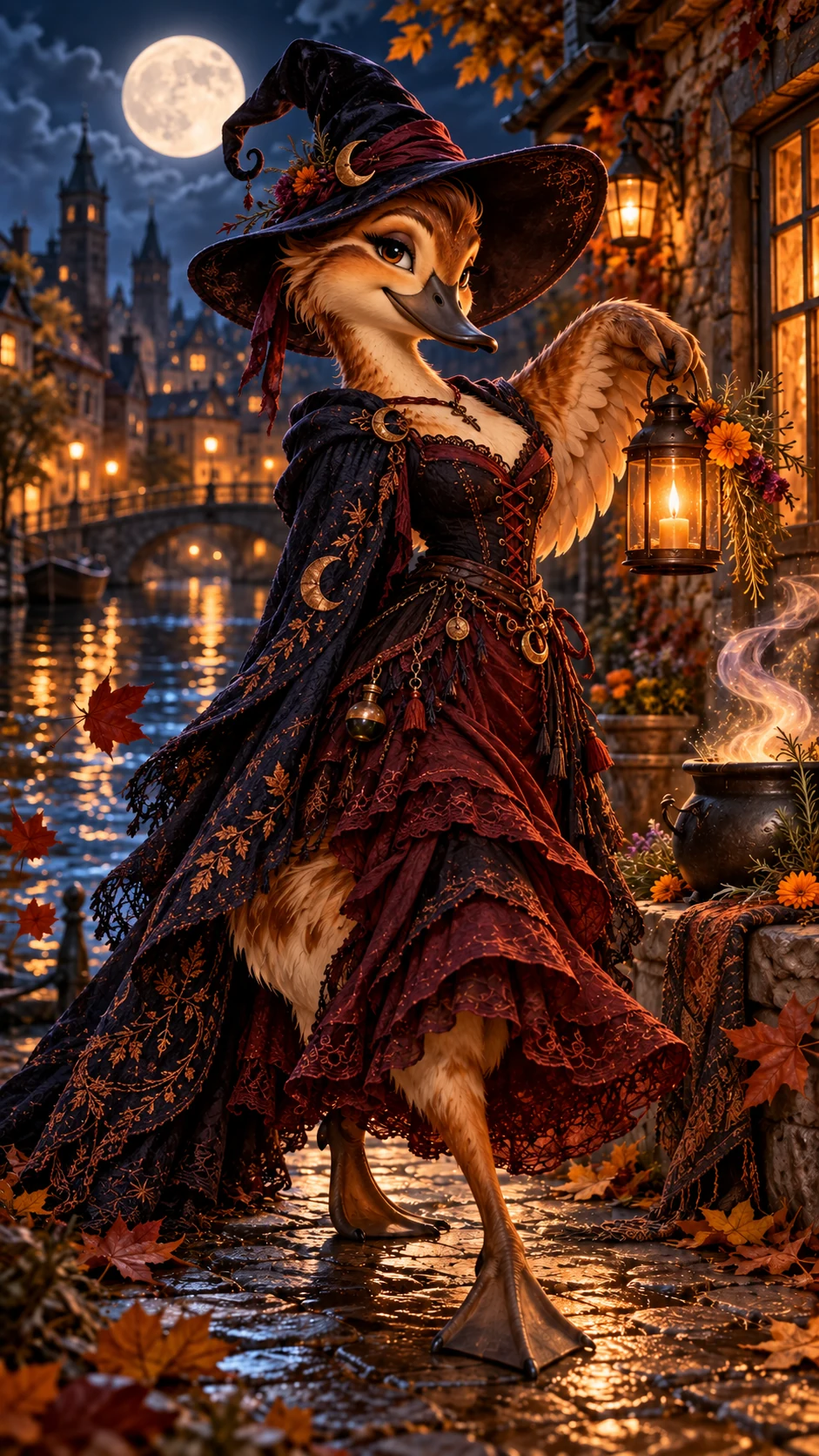
At the night market, between a stall selling warm chestnuts and a stall selling objects described as almost silver, Doña Candela found a frame she liked.
Unfortunately, it contained a painting.
The frame was dark oak, square and deep, with little carved reeds at the corners. The painting was a pale creature spread across a green background. One eye appeared to be reconsidering its position. Something red protruded from what might have been its mouth.
A card beneath it read: LOT TWELVE. A SWAN AT REST. ARTIST UNKNOWN.
“Was the artist questioned?” Candela asked.
The auctioneer, a small brown duck in a waistcoat with more buttons than cloth, adjusted the card.
“An arresting piece.”
“Yes. I imagine it could be used at the station.”
She had come for a frame to hold the price list in her shop. The old list had curled at the edges, allowing customers to claim that the cost of certain remedies remained a matter of interpretation.
This frame would hold a price still.
“Can I buy it without the swan?”
“The work is offered entire.”
“Does it have to face outward?”
Before the auctioneer could answer, a goose stopped beside her.
Honorius Honk wore his burgundy cravat and pince-nez. He had been walking through the market with the purposeful air of someone who wished to be seen having no interest in it.
Now he was interested.
He leaned toward the painting. Leaned back. Removed his spectacles. Put them on again.
“Who submitted this?”
“An estate clearance,” said the auctioneer.
“Whose estate?”
“The cleared one.”
Honorius looked at the pale creature’s neck, the red object, the raised eye. Then he looked at his own reflection in a brass bowl.
“That title is plainly inaccurate.”
Candela watched his cravat move.
“Oh,” she said.
“What?”
“Nothing. I had been wondering about the red part.”
“It is not a likeness.”
“Of course not. You stand much straighter.”
Across the canal, the lamps were coming on. A musician beneath the bridge tried the opening of a tune three times, apparently unwilling to commit himself to the rest. Customers drifted toward the auction table. They had heard the tone in Honorius’s voice. It promised entertainment without a cover charge.
The auctioneer lifted his little wooden hammer.
“We begin at two crowns.”
“Two,” said Candela.
“Four,” said Honorius.
She turned to him. “I only want the frame.”
“I am buying the object.”
“To enjoy it?”
“To remove it.”
A duck in a flour-dusted apron raised her wing. “Five.”
Honorius stared.
“It would be excellent over the ovens,” she said. “Nobody would linger.”
“Six,” he said.
A little girl at the front tugged her father’s coat.
“Why is the fish standing up?”
“Shh,” said her father. “It’s art.”
“Eight,” said the baker.
Candela kept her wings folded. At eight crowns she could buy a new frame, have her prices painted directly on the wall, and still afford to dislike something for free.
“Nine,” said Honorius.
The auctioneer’s face had brightened considerably. Until this evening, the painting’s greatest contribution to commerce had been keeping the wind off a box of spoons.
“An important work,” he announced.
“Since when?” asked Candela.
“Since nine.”
The little girl slipped around the side of the table. From there, she tilted her head.
“It’s definitely a fish.”
Her father offered her a chestnut. She accepted it without withdrawing the opinion.
Honorius was now standing directly in front of the canvas. A passerby tried to see around him.
“Kindly continue your journey,” he said.
“Is it yours?”
“Not yet.”
“Then move.”
The auctioneer asked for ten. The baker shook her head. Candela examined the frame’s lower corner. A small wedge of wood had been nailed there to repair a split. The repair was sound. The display wire, however, had been added recently; its bright screws were surrounded by several older holes.
She looked at the red thing again.
Then she stepped around the table to stand beside the little girl.
The child pointed with her chestnut.
“See?”
“I believe I do.”
“Nine crowns, going once,” said the auctioneer.
Candela lifted one wing. Honorius made a small, furious noise.
“I am not bidding,” she said. “Turn it.”
“We cannot accept alterations during a sale.”
“Then call it a viewing.”
The auctioneer glanced at the crowd, which had become large enough to obstruct the chestnuts. He grasped the frame and rotated it a quarter turn.
The swan vanished.
In its place sat a cat on a green cushion, holding an enormous red fish. The eye that had seemed to hover above a goose’s head was the cat’s second ear. The supposed bill was its tail.
It was still a very bad painting.
But it was, unmistakably, a different very bad painting.
“Oh,” said the baker.
The little girl ate her chestnut.
Honorius put one wing to his cravat.
“Naturally,” he said.
The auctioneer studied his card.
“A Cat with Fish,” he announced. “Nine crowns to the gentleman.”
“I withdraw.”
“On what grounds?”
“Fundamental misdescription.”
“You have had an uninterrupted view.”
“Of a swan.”
“Which you said was not a swan.”
“Precisely.”
Candela leaned against a post and allowed the exchange to improve without her help.
The auctioneer tapped the card. “You were bidding on the painting.”
“I was bidding under a material misunderstanding.”
The baker nodded. “He thought it was him.”
“I did not.”
“Then you must be delighted,” said Candela. “It isn’t.”
Somewhere near the chestnut stove, a duck began to laugh. Another joined him. Honorius watched the amusement travel through the crowd and realized that prolonging the argument was providing a service for which nobody would pay him.
He counted out nine crowns.
“Wrap it.”
“With pleasure,” said the auctioneer, who had been trying not to breathe in case it disturbed the sale.
Before the canvas disappeared beneath brown paper, the little girl asked whether she might see it once more.
Honorius hesitated. She was looking at the fish, not at him.
“Why?”
“Our cat brings things in. She looks exactly like that when she knows she shouldn’t.”
Her father looked at the picture properly for the first time.
“Your mother would refuse to put it up.”
“Not in my room.”
The child was already measuring an empty wall in her head.
Candela turned to Honorius.
“I’ll give you two crowns for the frame.”
“Two? You heard what I paid.”
“I also heard what you bought.”
He looked down at the cat. Without its frame, the canvas was small enough to fit beneath a young duck’s wing. Without its canvas, the frame was just the thing for a list of prices.
“And the painting?” he asked.
Candela nodded toward the child.
For a moment, Honorius looked almost offended by the simplicity of it.
Then he said, “No charge. Provided it is displayed in the correct orientation.”
The little girl promised. Her father thanked him. The auctioneer found a piece of string and helped secure the canvas for the walk home.
Honorius accepted Candela’s two crowns.
“A loss of seven,” he said.
“An evening out.”
“I usually have a better evening for seven crowns.”
“You could have had this one for nothing.”
She tucked the frame beneath her wing. He adjusted his cravat. They went their separate ways through the market while the musician beneath the bridge finally attempted the second part of his tune.
By the following afternoon, Candela’s prices hung firmly beside her door. No corner curled. No number could be mistaken for a lower one by a customer tilting their head.
Honorius passed the shop and paused to inspect the result.
Above the list, in small letters, she had added:
FRAME: TWO CROWNS.
He pointed at it.
“That is unnecessary.”
“I thought you valued a correct description.”
He left without buying anything.
Across Plume City, a little duck’s mother stood in a bedroom doorway, looking at a cat with a fish.
“Where on earth did you get that?”
“A very important goose gave it to me.”
Her mother considered the painting, then her daughter’s pleased face.
“Well,” she said. “He must have liked you.”
The little girl nodded.
Down at the night market, the auctioneer was turning every remaining picture sideways, just in case.