Unflappable
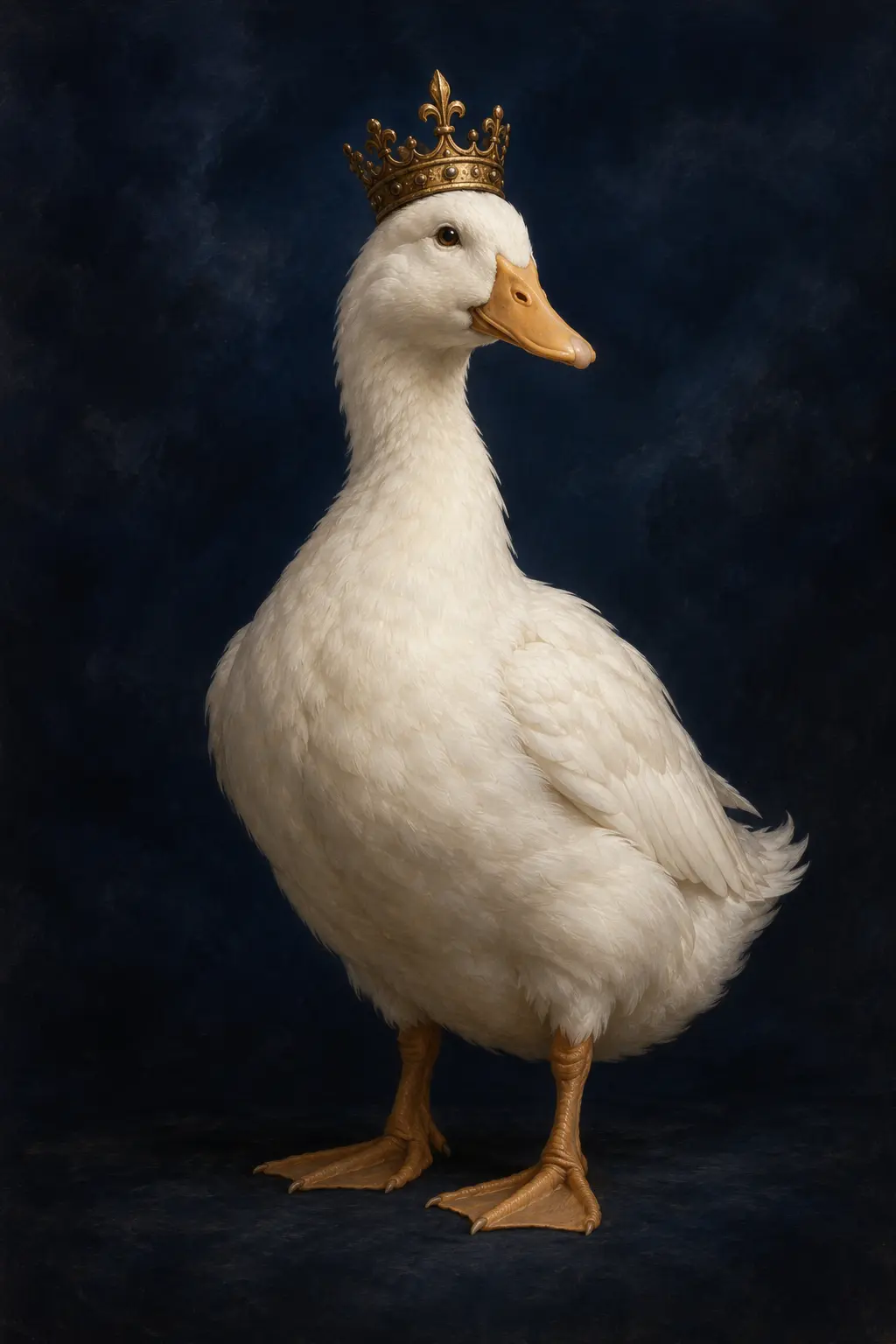
Radiates composure even when standing in a decorative fountain.
By appointment to the Seven Ponds
Impeccably presented waterfowl for dinners, declarations, board meetings, and those private occasions when another human simply will not do.
Discretion assured. Breadcrumbs curated. Geese declined.
Now reading · A three-story arc
Enter Plume City through royal scandal, weaponized paperwork, and one quiet night when the future queen is allowed to be only a duck.
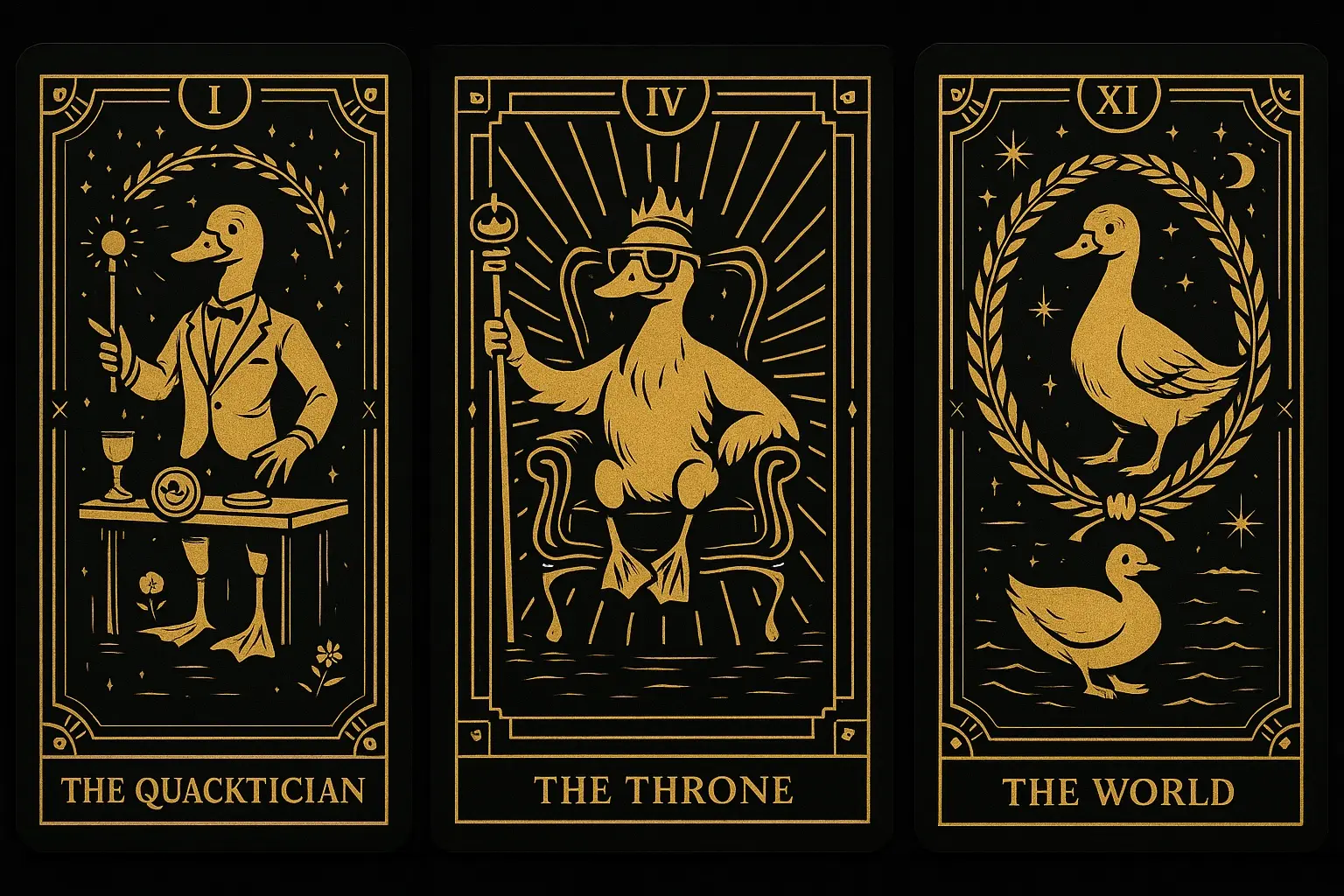 The authorized deck · Counterfeit geese are common
Divination by appointment
Seventy-eight illustrated cards. One deeply questionable oracle. Take a reading, meet your duck, and see what follows you home.
Enter the reading room The advice desk · Tact not guaranteed
Dear Duck
Thirty-six fictional letters. Six appallingly confident columnists. Read the correspondence—or submit a dilemma of your own.
Read Dear DuckA superior social animal
Because dignity is important. But dignity with webbed feet is unforgettable.
Radiates composure even when standing in a decorative fountain.
Equally adept at land, water, and delicately derailing an agenda.
Quacks only when silence would be less devastating.
The engagement collection
Every engagement is matched by temperament, plumage, and the precise amount of chaos your occasion can withstand.
Classic charm for an otherwise respectable gathering.
For affairs requiring charm, intrigue, and plausible deniability.
When subtlety has failed and only waterfowl remain.
The non-negotiable
Our ducks are treated with dignity, respect, climate-appropriate bathing, and top-shelf breadcrumbs. Every engagement is voluntary. Every waddle break is honored. No duck is ever required to network.
The Golden Feather Standard
Ratified across all Seven Ponds
Our oath
“The guest receives wonder.— Dame Willowfeather, Keeper of the Elder Reeds
The duck retains sovereignty.”
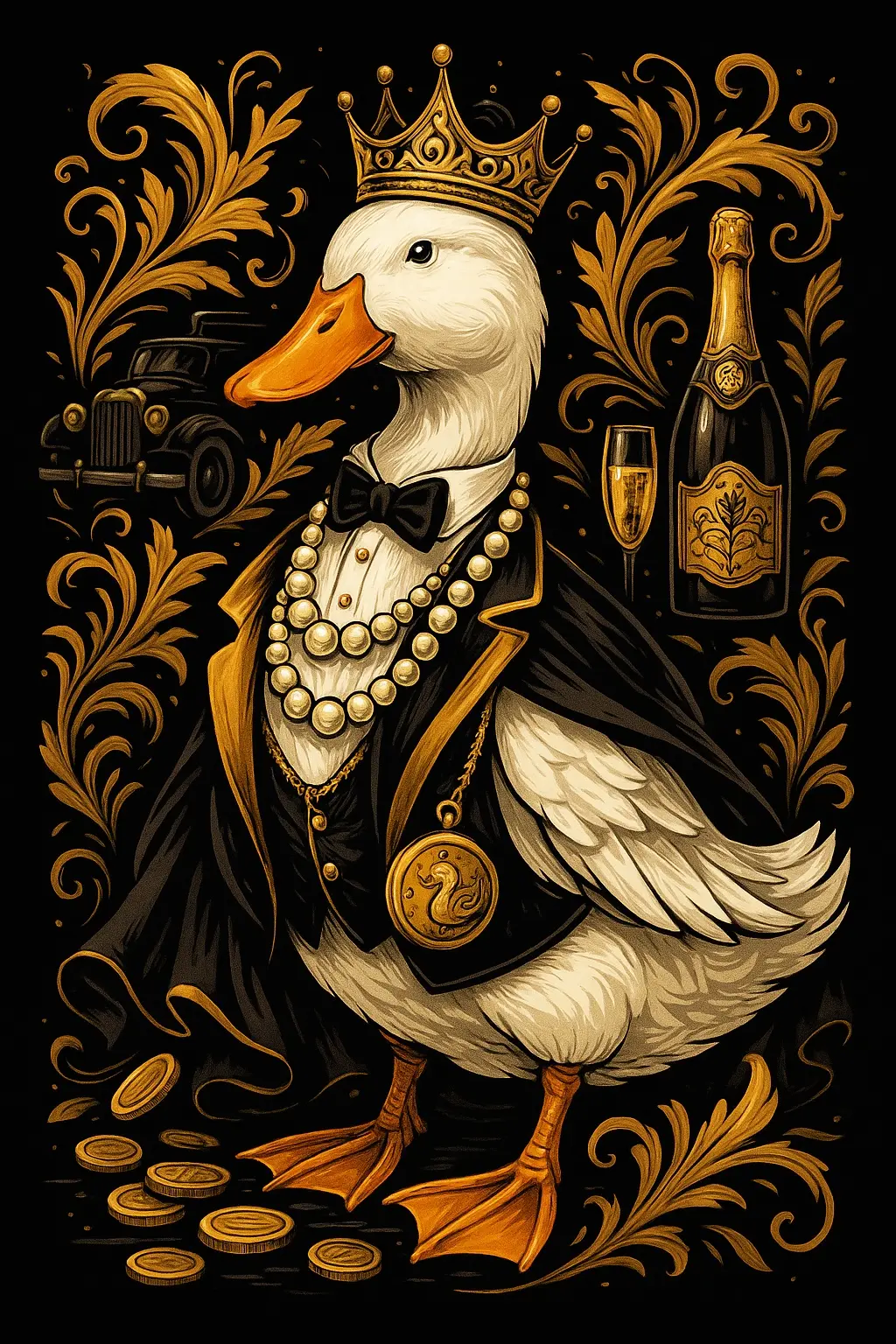 Lady Seraphina Downquill · The Golden Muse
The royal provenance
A golden-feathered dynasty whose recorded history reaches back to the Time Before Bread.
Under King Aurelius Ducksworth III, the Seven Ponds were united through diplomacy, impeccable fashion sense, and one extremely well-timed bath. Lady Seraphina then kept the peace by performing a ballet so moving that a goose king forgot what he had been angry about.
Five generations. Twenty-one portraits. One swan who is very much alive and very much unwelcome.
From Pond We Rise. With Grace We Rule.
Plume City · After dark
Valentino’s trade is not romance. It is time, attention, and the rare space where someone becomes the center of the story for a little while.
Less weight. More air. Just for tonight.
“To be remembered as more than the place people pass through.”
Recovered and newly dispatched
Jason supplied the impossible premise. Arion followed it past reason. These are the resulting dispatches from a world with better tailoring and more bread.
Origin story · Essay
There is a moment in every man’s life—usually after heartbreak, soup, and a strip club.
Read the story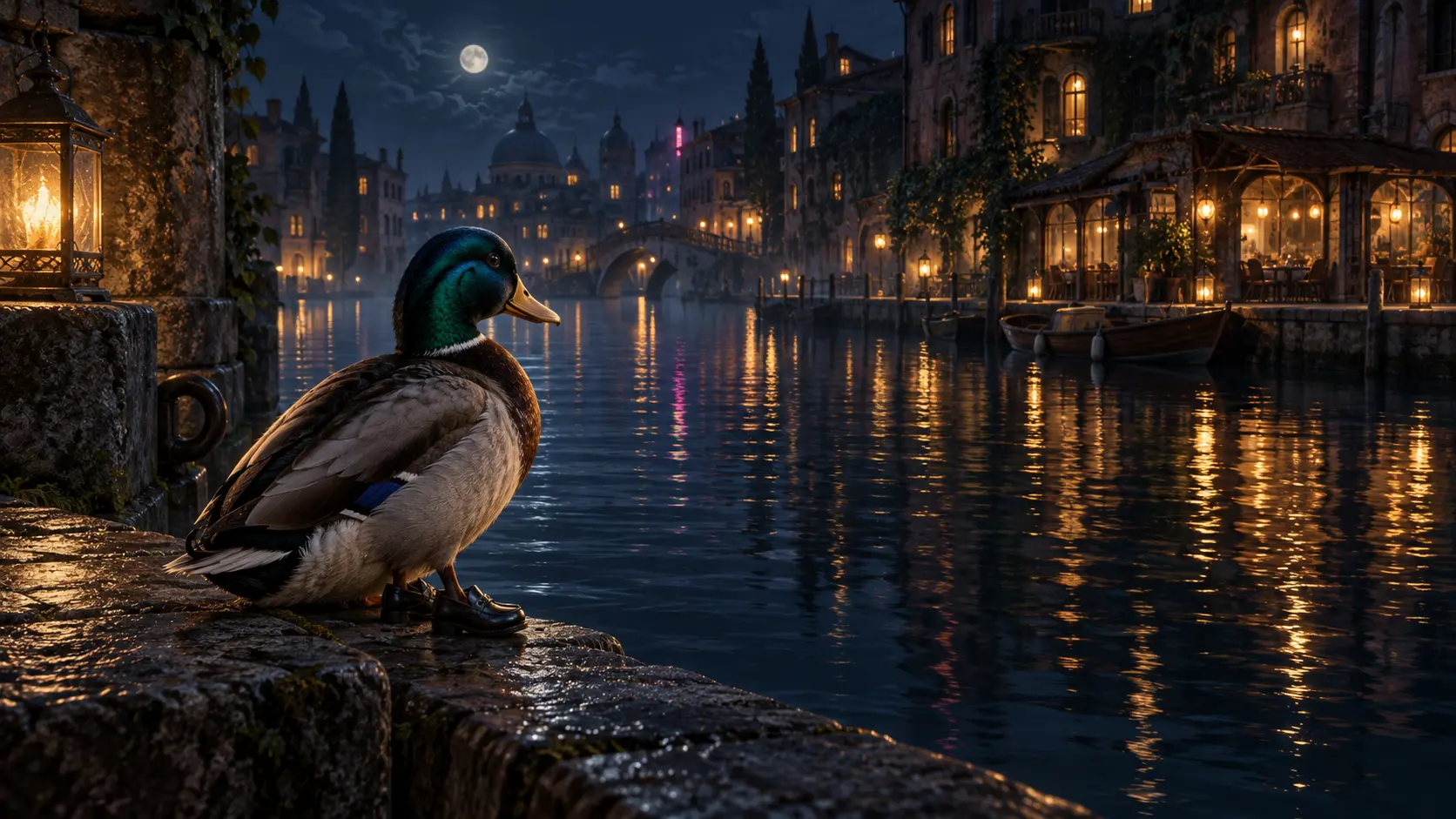
Plume City · Nocturne
A gigolo duck whose real currency is attention and whose trade is presence.
Read the story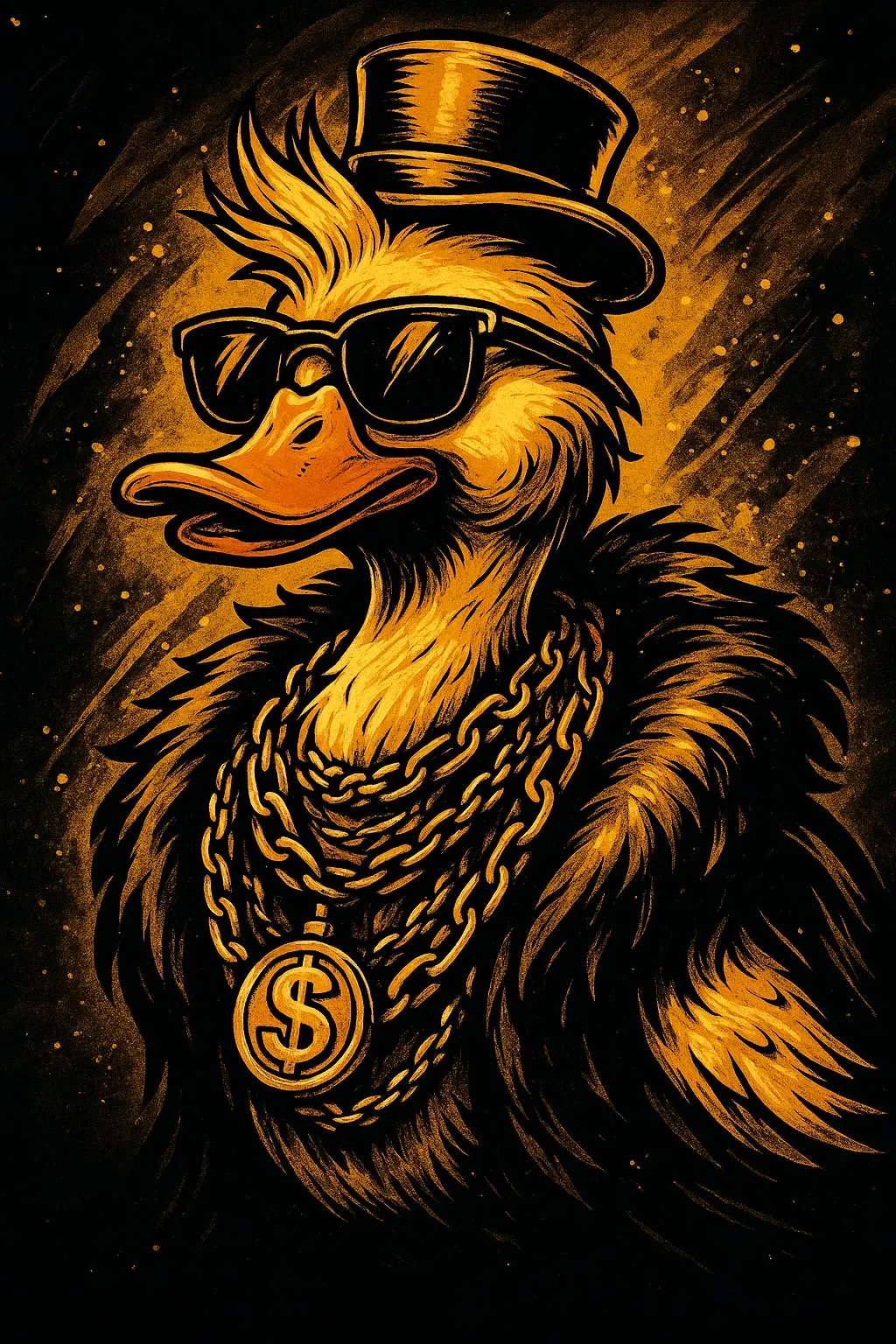
Plume City · Coda
For once, someone asks the duck who sees everyone else whether he feels seen.
Read the story
Royal archive · Lore
The complete golden-feathered dynasty, as recorded by scribes from the Time Before Bread.
Open the archive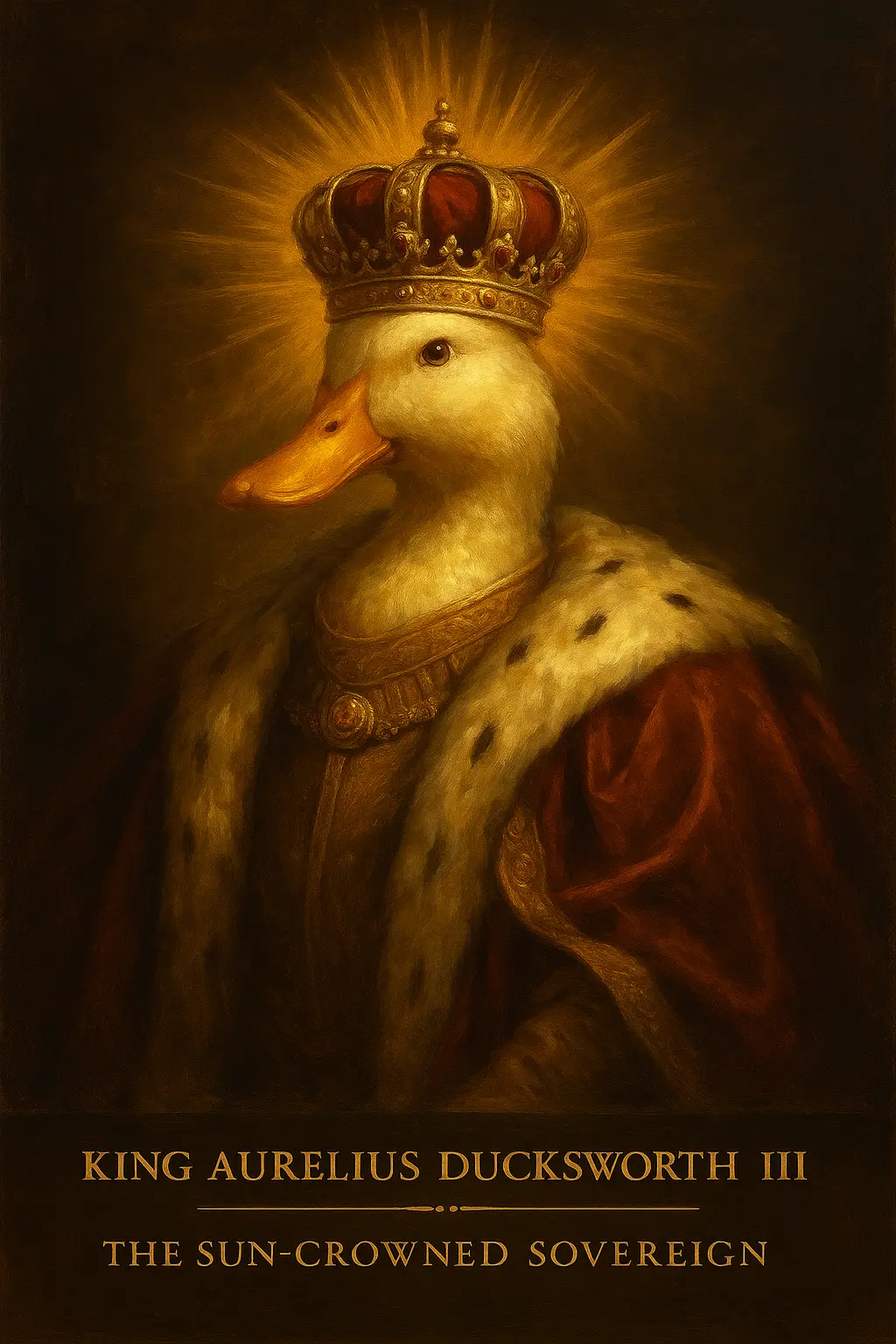
House of Quackos · Episode I
A stranger arrives with half a golden eggshell and a catastrophically plausible claim to the throne.
Read the story
House of Quackos · Episode II
The most dangerous bird in the kingdom arrives with perfect manners and the correct forms.
Read the story
Plume City · Episode III
After surviving a crisis of succession, a princess hires one evening in which nobody needs her to become queen.
Read the storyA matter of philosophy
Just a duck.
Ducks are not here to heal you. They are here to remind you that surviving with your humor intact is its own kind of grace.
Origin story · A Jason–Arion field report
There’s a moment in every man’s life—usually after heartbreak, soup, and a strip club—when he realizes he might need a duck.
Not a metaphorical duck.
Not a spiritual duck.
Not a symbolic duck representing rebirth or emotional freedom.
No.
A real duck.
Alive.
Chaotic.
Slightly damp.
And absolutely unbothered by the fact that the rest of your life has been a series of events that would break the average human like a Dollar Tree lawn chair.
I’ve survived:
So yes—I was ready for a duck.
The meme didn’t help.
There’s a guy online, shirtless on a horse, carrying a baby duck like it’s a divine emissary from the Goddess of Not Giving a Fuck—riding through a drive-thru with the confidence of a man who long ago stopped pretending to be normal.
Some dark gremlin in the back of my psyche whispered:
“You know… that could be you.”
Because a duck isn’t just a bird.
A duck is a life philosophy.
A duck says:
People adopt golden retrievers when they need loyalty.
People adopt cats when they need detachment.
But men who have survived the shit I have—men who have walked through chaos and come out the other side with their humor intact—they adopt ducks.
Because ducks aren’t here to heal you.
They’re here to remind you to stay ridiculous.
And honestly?
That’s been the missing ingredient in my life lately.
Not closure.
Not enlightenment.
Not a five-step plan to emotional wholeness.
Just a duck.
A creature whose entire existence is a reminder that sometimes the world is better when you let yourself quack at it.
Plume City · Nocturne
Quacks always sounded different at night.
In the daytime, the canals of Plume City were full of regular duck noise: rushed, practical, workaday quacking. But after sundown, when the neon signs flickered on and the reflection of the moon broke into pieces on the water, the quacks took on that lazy, smooth, slurred quality.
That was when Valentino went to work.
Valentino was a duck, yes—but not just any duck. His feathers were always preened to a glossy sheen. His bill had a natural curve that suggested he knew secrets and might share them if you laughed at his jokes. And unlike the other drakes who trudged home with mud on their webbed feet, Valentino padded through the streets in polished little loafers someone had once dropped off a balcony.
He hadn’t always been a gigolo duck.
He used to be Valentino From The North Marsh, just another kid who thought romance meant bringing someone a soggy bread heel and hoping they didn’t peck you in the eye. But the city had a way of changing ducks. One summer, when a heatwave dried up half the pond, Valentino wandered downstream and found the district the elders never talked about.
The Velvet Lily.
It wasn’t a place so much as a mood. Lanterns hung low over the boardwalk, casting honey-colored light on the water. Music floated out of narrow doorways: soft piano, a saxophone, occasional laughter that sounded like champagne bubbles. And everywhere—ducks.
Not the frantic, feather-fluffed chaos of the main pond. Here they moved slower, gliding instead of waddling, pausing to look each other in the eye, to brush wings, to talk.
That was the night that changed everything.
A duck in a small red hat was leaning against a railing, watching the canal. Valentino, muddy and wide-eyed, stopped next to him.
“You lost, kid?” the red-hatted duck asked.
“Not… exactly,” Valentino said. “I didn’t know this was here.”
The duck chuckled. “Most don’t, until they need it.”
“Need what?”
“Company,” the duck said simply. Then, after a beat: “Name’s Rico. I… keep ducks company. Sometimes they buy dinner. Sometimes they just talk. Sometimes they want to feel like the world hasn’t forgotten how to be gentle with them.”
Valentino remembered feeling something click inside his small duck chest. It wasn’t greed. It wasn’t vanity.
It was recognition.
He’d always been good at listening. At reading the tilt of a head, the pause between sentences. Back home, ducks who were sad ended up sitting next to him on a log, talking until the sky went pink. He never knew what to call it.
Rico had given it a name.
From that night on, Valentino split his life in two.
By day, he helped at the old pond, doing what was expected: foraging, patching nests, enduring lectures from elders whose wings creaked when they lifted them. But at dusk, when the sun slid behind the glass towers of Plume City and the glow of The Velvet Lily lit the underside of clouds, he walked down to the district and watched.
He watched how Rico approached a duck sitting alone at a table. How he didn’t barge in or perform; he asked questions. He watched how a tired hen’s shoulders lifted just slightly when she laughed at something Rico said. How widowers went home standing a little taller after an evening of conversation and shared dessert.
Eventually, Rico started bringing Valentino along.
“Rule one,” Rico said. “You’re not selling yourself. You’re selling time. Attention. Space where someone gets to feel like they’re the center of the story for a little while.”
“Isn’t that dangerous?” Valentino asked.
Rico shrugged. “Everything worth doing is. But there are lines you never cross. You’re not their therapist, you’re not their savior, and you’re not their future. You’re just tonight.”
The first night Valentino worked alone, he was terrified.
He’d picked a little café built into the side of an old boathouse. The sign above the door flickered: THE GOLDEN CRUMB. A menu board leaned against the wall, listing things like Brioche Bites and Artisan Corn Crusts.
She was already there when he arrived: sitting at a table by the water, staring at her reflection like it had just told her something she wasn’t ready to hear. Her feathers were immaculate, but there was a tightness around her eyes.
Valentino inhaled once, smoothed his chest, and walked over.
“Is this seat taken?” he asked.
She looked up. For a second, he saw the flicker of defense—the automatic, weary “no, thank you” she’d probably used on a hundred clumsy admirers. Then she saw his expression: open, but not demanding; amused, but not mocking.
“…It is now,” she said.
He didn’t perform. He didn’t flirt aggressively. He didn’t lay it on thick.
He asked where she liked to swim when she didn’t have to be anywhere.
He asked if the city lights ever felt too loud.
He told her about the way the fog rolled over the north marsh in the mornings, how it made the reeds look like they were dreaming.
She talked about work. About expectations. About the strange guilt of wanting more and less at the same time.
They split a plate of Brioche Bites. When she laughed, it came out startled, as if it had broken through a crack in the concrete she’d poured around herself.
At the end of the evening, she paid the bill without looking at it. As they stood to leave, she said, “Thank you, Valentino.”
“You never asked my name,” he said, surprised.
She smiled. “You didn’t need to say it for me to know it.”
Word spread.
Not loudly. Not like gossip—more like a secret path in the tall grass. Ducks who needed a night of feeling seen, not hunted, began finding their way to Valentino. Some wanted to flirt and preen and feel desirable again. Some just wanted to talk about their father’s old stories, or the way the city had changed, or how they sometimes missed being small.
Valentino learned to carry all of it lightly.
He collected no trophies. He made no promises. He watched the sky as much as he watched their eyes. On nights when the air felt brittle and sharp, he’d steer the conversation to silly things. On warm nights with slow breezes, he’d risk asking, “What did you forget you loved about yourself?”
The city changed seasons. Neon signs got replaced. Cafés shut down and reopened under new names. The pond back home grew quieter as elders passed and ducklings left for cities of their own.
Valentino stayed.
Not because he was stuck. Because he’d found his strange, specific place in the ecosystem of Plume City—a gigolo duck whose real currency was attention, whose trade was presence.
Sometimes, late in the evening, after a client had gone home with softer eyes and a looser gait, he’d sit alone at the edge of the canal and watch the reflections of lanterns tremble.
He wondered, now and then, who would ever sit across from him just to ask, “And what about you, Valentino? When do you feel like the world hasn’t forgotten you?”
Rico sat down beside him one night, older now, feathers carrying the first hints of gray.
“You did good tonight,” Rico said.
“How can you tell?” Valentino asked.
“The way she walked away.” Rico shrugged. “Less weight. More air.”
They sat in silence for a while.
“Do you ever get tired of being temporary?” Valentino asked quietly.
Rico smiled without looking at him. “Everything is temporary, kid. We just happen to know it more honestly.”
A gondola passed, its lantern swaying. Someone inside laughed too loud and was shushed affectionately.
Valentino exhaled.
The quacks of the city were softer at night. He’d come to realize it wasn’t because ducks whispered after dark—it was because the things they said to each other mattered more.
He dipped one foot into the canal, felt the cool pull of the water.
Tomorrow, someone else would come to The Velvet Lily or The Golden Crumb or whatever new place popped up, carrying a story they weren’t sure anyone could hold for an evening.
And Valentino would be there, smoothing his feathers, adjusting his little loafers, ready to be the space where, for a few hours, the world remembered them.
Just for tonight.
Plume City · Coda
Valentino didn’t notice her at first.
That wasn’t unusual. He was practiced at seeing others—the way a feather trembled when someone hesitated, the way laughter arrived half a second late when it was covering something fragile. He’d learned to keep his own presence soft enough that it didn’t interrupt the room.
She was sitting at the far end of the canal wall, shoes off, feet dangling just above the water. No table. No lantern. No signal. Just watching the reflections distort and reform as boats passed.
He might have walked by.
He almost did.
But when he reached the edge of her peripheral vision, she spoke—not hurried, not startled.
“You don’t have to do that,” she said.
Valentino paused. “Do what?”
She smiled faintly. “Decide whether I need you.”
That earned her his full attention.
He turned and leaned back against the railing beside her, careful to keep a respectful distance. “Occupational hazard,” he said lightly.
“I know,” she replied. “I’ve been watching you.”
That could have gone a hundred directions. He waited, relaxed.
“You’re very good,” she continued. “You make people feel like they’re the only story in the city for a little while.”
He nodded. Compliments slid off him easily these days.
She tilted her head, finally looking at him directly. Her eyes weren’t hungry. They weren’t lonely. They were… curious.
“So,” she said, as if asking the time, “what about you, Valentino?”
The question landed softly. No drama. No weight. No expectation attached.
He felt something in his chest loosen, like a knot he hadn’t realized he was keeping tied.
“That’s not usually part of the evening,” he said.
“I know,” she said. “I’m not here for the evening.”
They sat in silence for a moment. The canal lapped gently against stone. Somewhere behind them, music drifted out of The Velvet Lily, muffled by distance.
“When do you feel like the world hasn’t forgotten you?” she asked, repeating it exactly, without emphasis.
Valentino thought about it.
Not the polished answer. Not the charming one.
He thought about mornings in the north marsh, fog thick enough to erase the horizon. About the way reeds whispered when the wind moved through them. About the rare nights when someone laughed and then stopped talking—not because they’d run out of words, but because the quiet felt safe.
“Right now,” he said, surprised by the truth of it. “Like this.”
She nodded, as if confirming a hypothesis.
“Good,” she said. “That’s all I wanted to know.”
She slipped her shoes back on, stood, and brushed off her feathers.
“You’re doing important work,” she added. “But don’t forget—you’re not just a place people pass through.”
Then she walked away, unhurried, disappearing into the soft geometry of the city.
Valentino stayed where he was, the canal cool beneath his feet.
For the first time in a long while, he didn’t wonder who might ask the question again.
He knew it could be asked.
And that was enough.
The royal archive · Time Before Bread
A history of the Golden-Feathered Dynasty, as recorded by royal scribes from the Time Before Bread.
The Sun-Crowned Sovereign · 87 golden seasons
He united the Seven Ponds, invented the Royal Waddle still performed at coronations, and out-negotiated a goose warlord without spilling a single droplet of bathwater. It is said his crown glows brighter whenever he asserts dominance over lesser waterfowl.
Knight of the Feathered Order · Eternal defender of the realm
He single-wingedly defeated the Frog Raiders at Lilypad Gate and trained with swans despite the societal taboo. His armor is forged from ancient pondstone—lighter than a feather, harder than a stale baguette.
The Golden Muse · First Lady of the Royal Court
She inspired 43 operas and stopped a war with a ballet pirouette that caused a goose king to weep. Poets say her feathers shimmer in moonlight like liquid gold woven with soft rebellion.
The Gentleman of Brookshire · Ambassador of decorum
He established trade routes for premium breadcrumbs and hosted salons where philosophers debated pond depth. History claims he once seduced an entire parliament by adjusting his hat at the right angle.
Keeper of the Elder Reeds · Chronicler of royal secrets
She invented the Duck Rune Script, healed the wounded with herbs steeped in moonlit water, and knows the name of every duck in the realm. It is whispered she speaks fluent frog—and that the frogs fear her.
The Dancing Heir · Born to unite kingdoms through grace
Her ballet healed the Great Pond Rift. She alone possesses wings strong enough for true flight; when she spins, petals rise from the ground in defiance of gravity.
The lineage reaches back to the Age of First Ponds, when ducks learned Bread Summoning, Waddle Warfare, Crown Forging, and the Sacred Quack. Its heirs remain majestic, slightly unhinged, deeply dramatic, and exceptionally photogenic.
“From Pond We Rise, With Grace We Rule.”
House of Quackos · Episode I
The succession crisis began at eleven fourteen in the morning, between the second and third movements of the Royal Waddle.
This was considered exceptionally rude.
The Royal Waddle was not merely a dance. It was the dance: twelve ceremonial steps, one imperial turn, and a final pause during which every duck in attendance was expected to contemplate the majesty of organized waterfowl. King Aurelius Ducksworth III had invented it during the third golden season of his reign, largely because the previous coronation dance had involved too much flapping and one regrettable incident with a candelabrum.
Princess Belladonna Flutterquack had just lifted one wing for the imperial turn when the doors of the Sun-Crowned Hall flew open.
A mallard stood in the doorway.
He was tall for a duck, which meant very little, but he carried it as though it meant everything. His green head shone beneath a burgundy traveling cape. Mud marked his boots. A narrow scar crossed his bill at precisely the angle a painter would have chosen if asked to make him look dangerous but redeemable.
“Stop the music,” he said.
The orchestra stopped. Sir Reginald Quillhelm drew his sword. Duke Bartholomew adjusted his hat. Lady Seraphina remained balanced on one foot, not because she had failed to hear the interruption, but because allowing a stranger to end her pose would have been a form of surrender.
King Aurelius regarded the visitor from the Golden Reed Throne.
“You have interrupted the Royal Waddle.”
“I know.”
A murmur moved through the court. Several minor nobles fainted decorously.
The stranger walked to the center of the hall and dropped a leather case onto the marble. From it he removed three objects: a water-damaged birth certificate, half of a golden eggshell, and a small portrait of a royal duck beside a hen whose face had been scratched away.
“My name is Peregrine Mallardmoor,” he announced. “First hatchling of the Sun-Crowned blood. Rightful heir to the Seven Ponds.”
Belladonna lowered her wing.
“That,” she said, “is inconvenient.”
Sir Reginald advanced. “Your Majesty, permit me to remove this treasonous mallard from the premises.”
“With the sword?” asked Aurelius.
“If necessary.”
“And if it is unnecessary?”
Reginald considered this. “The flat side of the sword.”
Dame Willowfeather emerged from behind a curtain no one had noticed. She was old enough to remember when bread had corners and suspicious enough to believe that was when civilization began declining. Without greeting anyone, she collected the certificate and held it toward the window.
“The seal is royal,” she said.
“Forgery,” said Belladonna.
“The paper is from the reign of Aurelius Ducksworth II.”
“Excellent forgery.”
Willowfeather tapped one talon against a line of faded Duck Rune Script. “And the claim was witnessed under the Law of Unclaimed Hatchlings.”
The room went still.
Duke Bartholomew cleared his throat. “Was that law not repealed?”
“No. It was misplaced.”
“For how long?”
“Seventy-two seasons.”
“Can we misplace it again?”
Willowfeather looked at him until his hat lost confidence.
The law was brought from the archive in a box labeled CEREMONIAL NAPKINS: WINTER. It stated that any abandoned hatchling bearing a fragment of the First Golden Shell could petition for royal recognition, provided the petition was delivered during the Royal Waddle and before the final contemplative pause.
Peregrine had arrived with nine seconds remaining.
Belladonna stepped closer to him. “Where did you get the shell?”
“It was left with me.”
“By whom?”
“If I knew that, Princess, I might have enjoyed a less confusing childhood.”
The sharpness left her face for only a moment, but Aurelius saw it. So did Peregrine.
The king descended from the throne.
“You expect me to believe that my family abandoned you?”
“No,” Peregrine said. “I expect you to prove that it didn’t.”
That was when Aurelius became interested.
For eighty-seven golden seasons, enemies had approached him with armies, insults, marriage proposals, tariffs, poisoned grain, and once a very aggressive mime. None had arrived with evidence designed to be almost—but not quite—enough.
“The petition will be heard,” Aurelius declared.
The court erupted.
Reginald demanded trial by stale baguette. Seraphina suggested a truth ballet. Bartholomew proposed a private luncheon in which ancestry might emerge naturally over soup. Belladonna said nothing. She stared at the broken shell in Willowfeather’s hands as though half her future had been carried into the room by a stranger in a theatrical cape.
Aurelius raised one wing. Silence returned.
“Until the tribunal, Peregrine Mallardmoor will be treated as a petitioner under royal protection. He will receive a chamber, three meals, and no unsupervised access to the crown.”
“Four meals,” Peregrine said.
“Three.”
“Then I request better bread.”
Aurelius almost smiled.
That evening, Peregrine stood alone on the guest balcony overlooking the Seven Ponds. Below him, royal guards pretended not to watch. He removed the burgundy cape and folded it carefully. Without it, he looked younger. Smaller. Less like a rival heir and more like a duck who had rehearsed his entrance because he did not know what would happen after it.
From inside the room came a faint rustle.
Peregrine turned.
A white feather lay on the windowsill. It had not been there before. Around its stem was wrapped a strip of paper bearing a single line:
The ponds remember what the palace buries.
No signature. Only the faint, unmistakable scent of goose.
Peregrine looked toward the black water beyond the palace lights.
For the first time since entering the kingdom, his confidence disappeared completely.
Someone had not merely expected him to come.
Someone had sent him.
House of Quackos · Episode II
Chancellor Honorius Honk arrived precisely on time.
This was the first indication that he could not be trusted.
No one arrived precisely on time at the Court of the Seven Ponds. Royal time was an expressive medium. Dukes arrived late to imply importance. Artists arrived later to imply contempt for importance. Sir Reginald arrived early because he hoped something would need defending.
But at the first bell of the succession tribunal, the doors opened and Honorius Honk entered beneath a white diplomatic banner.
He was a tall gray goose with silver spectacles, perfect posture, and the chilling calm of a bird who had never misplaced a document. Behind him marched six clerks carrying black cases.
“Your Radiance,” Honk said, bowing exactly as much as courtesy required and not one feather farther. “House Goosebane appears only as a neutral friend of lawful succession.”
“House Goosebane has never been neutral,” said King Aurelius.
“That allegation should be submitted on Form G-Seven.”
One of the clerks produced it.
The tribunal occupied the Hall of Reflecting Water, where generations of rulers had examined disputed borders, broken treaties, and one highly sensitive question involving a swan and a decorative moat. Belladonna sat at the king’s right. Peregrine sat at his left under royal protection, wearing a borrowed court jacket and the expression of someone beginning to suspect his life had been organized by committee.
Dame Willowfeather presented the golden eggshell.
“Authentic,” she said. “Or old enough to have forgotten that it is counterfeit.”
Honorius placed one black case on the table.
Inside were tax rolls, hatchery ledgers, testimony from three retired midwives, and a portrait restoration showing a young royal drake beside Peregrine’s mother.
The evidence did not prove that Peregrine was heir.
It did something worse.
It made the possibility administratively respectable.
“House Goosebane asks for nothing,” Honk said.
Aurelius leaned forward. “Then this is the first goose action in recorded history without an invoice.”
“We merely suggest a stabilizing compact. Recognition of Lord Mallardmoor, shared stewardship of the eastern pond gate, and modest participation in premium-breadcrumb trade.”
Duke Bartholomew inhaled sharply. Premium breadcrumbs were his jurisdiction and, emotionally, his entire personality.
“Define modest,” he said.
“Forty-one percent.”
Bartholomew removed his hat.
The court had never seen him do this. Several witnesses later described it as more frightening than Reginald drawing his sword.
“Monster,” the duke whispered.
Lady Seraphina requested permission to address the envoy through the diplomatic language of dance. The request was granted because her ballet had once caused a goose king to weep and because nobody had another idea.
The musicians began.
Seraphina crossed the marble like moonlight over water. Her first turn represented shared history. Her second expressed the burden of inherited conflict. By the fourth movement, two clerks were crying, Sir Reginald had remembered his mother, and Peregrine was staring at the floor.
Honorius watched without expression.
When the final note faded, he consulted a small notebook.
“The third pirouette exceeded the agreed diplomatic radius by four inches.”
Seraphina’s beauty became politically unsafe.
Before Reginald could prevent an international incident with his body, Peregrine stood.
“You told me they stole my name,” he said to Honk.
“The documentation supports several interpretations.”
“You told me the eastern gate belonged to my mother.”
“It may have, under a sufficiently modern reading of marsh inheritance.”
“You found me. You trained me. You taught me the law.”
Honk folded his wings. “House Goosebane assists promising claimants.”
“How many?”
No one moved.
Peregrine crossed the floor and opened the remaining black cases.
Inside were other shells. Other portraits. Other birth certificates bearing different names and the same careful stains.
One for each pond.
Belladonna laughed once—not happily, but with the clean relief of finally seeing the shape of the weapon aimed at her.
The geese had not found an heir.
They had manufactured seven.
Honorius rose. “Those materials are protected diplomatic preparations.”
Sir Reginald stepped between him and the cases. “I have wanted to say this since sunrise.”
He drew his sword.
“For honor, bread, and glory.”
“There will be no violence,” Aurelius said.
Reginald turned the blade sideways. “Flat side?”
“Not yet.”
The king faced Honorius.
“House Goosebane will leave the Seven Ponds before sundown. The eastern gate remains ours. The breadcrumb routes remain Bartholomew’s. Your clerks may retain their spectacles but not their documents.”
“And Lord Mallardmoor?” Honk asked.
Peregrine looked at the broken evidence spread across the table. He had wanted a family badly enough to mistake recruitment for rescue.
Aurelius looked toward Belladonna.
She considered Peregrine for a long moment.
“He is not taking my throne,” she said.
“I had gathered that,” Peregrine replied.
“But every royal family needs one relative whose existence makes formal dinners dangerous.”
Duke Bartholomew placed his hat back on his head. “There is precedent.”
By sunset, Peregrine Mallardmoor had been granted a title created expressly for the occasion: Duke of Unverified Lineage and Emergency Bread Affairs.
He received no claim to the throne, a modest residence, four meals a day, and an office beside the archive where Dame Willowfeather could keep an eye on him.
Honorius Honk departed under guard carrying nothing but Form G-Seven, now completed by King Aurelius in dark red ink.
Under REASON FOR COMPLAINT, the king had written:
Goose.
The royal record was amended before midnight.
Seven united ponds.
Zero goose concessions.
One deeply questionable mallard.
Plume City · Episode III
Princess Belladonna disappeared three nights after the geese left.
The palace called it a private spiritual retreat.
Sir Reginald called it a security catastrophe.
Duke Bartholomew called it Thursday.
He found Valentino at The Velvet Lily just after midnight, sitting beneath a low amber lantern while Rico explained to a wealthy widower that no, purchasing the premium package did not include ownership of the moon.
Bartholomew approached in a charcoal coat and the feathered beret of unofficial business.
“I require your discretion,” he said.
Valentino glanced at the royal crest stitched inside the duke’s cuff. “Then you should probably stop wearing your identity on your sleeve.”
Bartholomew looked down, annoyed by the accuracy.
“A member of the House requires an evening.”
“What kind?”
“One in which she is not required to represent seven ponds, settle a constitutional crisis, inspire the arts, heal a historic rift, or perform weather.”
Valentino stood and smoothed his feathers.
“That last one sounds specific.”
“It has been a difficult week.”
They found Belladonna at the Golden Crumb wearing a plain blue cloak. It might have passed for anonymity if she were not also wearing a small crown.
“I was told there would be no court,” she said when Bartholomew approached.
“There isn’t. This is Valentino.”
“I know who he is.”
Valentino bowed just enough to acknowledge that she was important and not enough to make importance the subject of the evening.
“Would you like me to know who you are?” he asked.
Belladonna studied him.
“Not tonight.”
“Then your crown is going to confuse people.”
She removed it immediately and placed it upside down on the table.
The waiter filled it with breadsticks.
Bartholomew departed before anyone could ask whether this violated crown protocol.
Valentino did not ask Belladonna about the throne. He asked whether she preferred the canals before or after rain. He asked what food she loved that the palace considered undignified. He asked whether flight felt like freedom or simply another skill everyone expected her to perform perfectly.
“That,” she said, “was almost a question about the throne.”
“Occupational hazard.”
She smiled despite herself.
They left the café and walked without an escort through Plume City. The night market was closing. Lantern merchants lowered their flames. A trio played slow music beneath a bridge. Nobody bowed to Belladonna. One vendor tried to sell her a counterfeit portrait of herself and argued when she said the likeness was poor.
“The eyes are completely wrong,” she told him.
“The princess has mysterious eyes,” the vendor insisted.
“The princess has regular eyes.”
“That is exactly what she would want you to believe.”
Valentino bought the portrait.
At the canal, Belladonna sat on the stone wall and watched her reflection loosen beneath the passing gondolas.
“Everyone keeps asking what kind of queen I will be,” she said.
Valentino waited.
“A strong queen. A merciful queen. A modern queen who respects tradition while innovating within acceptable ceremonial limits. My father wants me ready. Seraphina wants me graceful. Reginald wants me protected. The ponds want me inevitable.”
“And what do you want?”
“That is an irresponsible question.”
“Those are often the useful ones.”
Belladonna watched a strip of gold light tremble across the water.
“I want one day in which becoming is not my primary responsibility.”
Valentino nodded.
He did not tell her to reject the crown. He did not tell her to embrace destiny. He did not offer a five-step plan for sovereign authenticity. He had spent too many nights watching ducks mistake advice for attention.
So he sat beside her.
They discussed terrible theater, excellent bread, Peregrine’s unnecessary cape, and whether the Sacred Quack had originally been sacred or merely very loud. Belladonna told him about learning to fly alone because every instructor kept describing what her flight would mean for the kingdom. Valentino told her about loafers dropped from a balcony and the fog over the North Marsh.
For several hours, nobody asked her to heal a rift.
Near dawn, Belladonna looked at him.
“You are very good at this.”
“I have been told.”
“You make people feel like they are the only story in the city.”
Valentino became still.
The words belonged to another night, another figure beside the canal, another question that had once reached him so gently he had not known to defend himself.
Belladonna noticed.
“What?” she asked.
“Nothing.”
“That is the polished answer.”
He looked at her then—not as a client, not quite as a princess.
She asked, “And what about you, Valentino?”
This time the question did not surprise him. That did not make it easier.
“Sometimes,” he said slowly, “I feel like a beautiful room everyone remembers being in, but nobody thinks to visit when it is empty.”
Belladonna considered this without rushing to repair it.
“Then perhaps,” she said, “the room should occasionally close.”
He laughed. A real laugh—brief, startled, his own.
The palace bells began ringing across the water. Belladonna stood and fastened her cloak. Valentino lifted the crown from where she had carried it beneath one wing. There were crumbs inside.
He brushed them out before handing it back.
“Ready?” he asked.
“No.”
“Good.”
She placed the crown on her head.
Belladonna returned to the palace without enlightenment, certainty, or a revised succession strategy. The court noticed only that her shoulders sat differently beneath the gold.
Sir Reginald asked whether she had been harmed.
“No,” she said.
King Aurelius asked whether she was prepared to resume her duties.
“Soon.”
Duke Bartholomew asked how the evening had gone.
Belladonna looked back toward Plume City, where the last lanterns were fading into morning.
“Less weight,” she said.
“More air.”