Plume City · A standalone story
The Echo Asked for Lunch
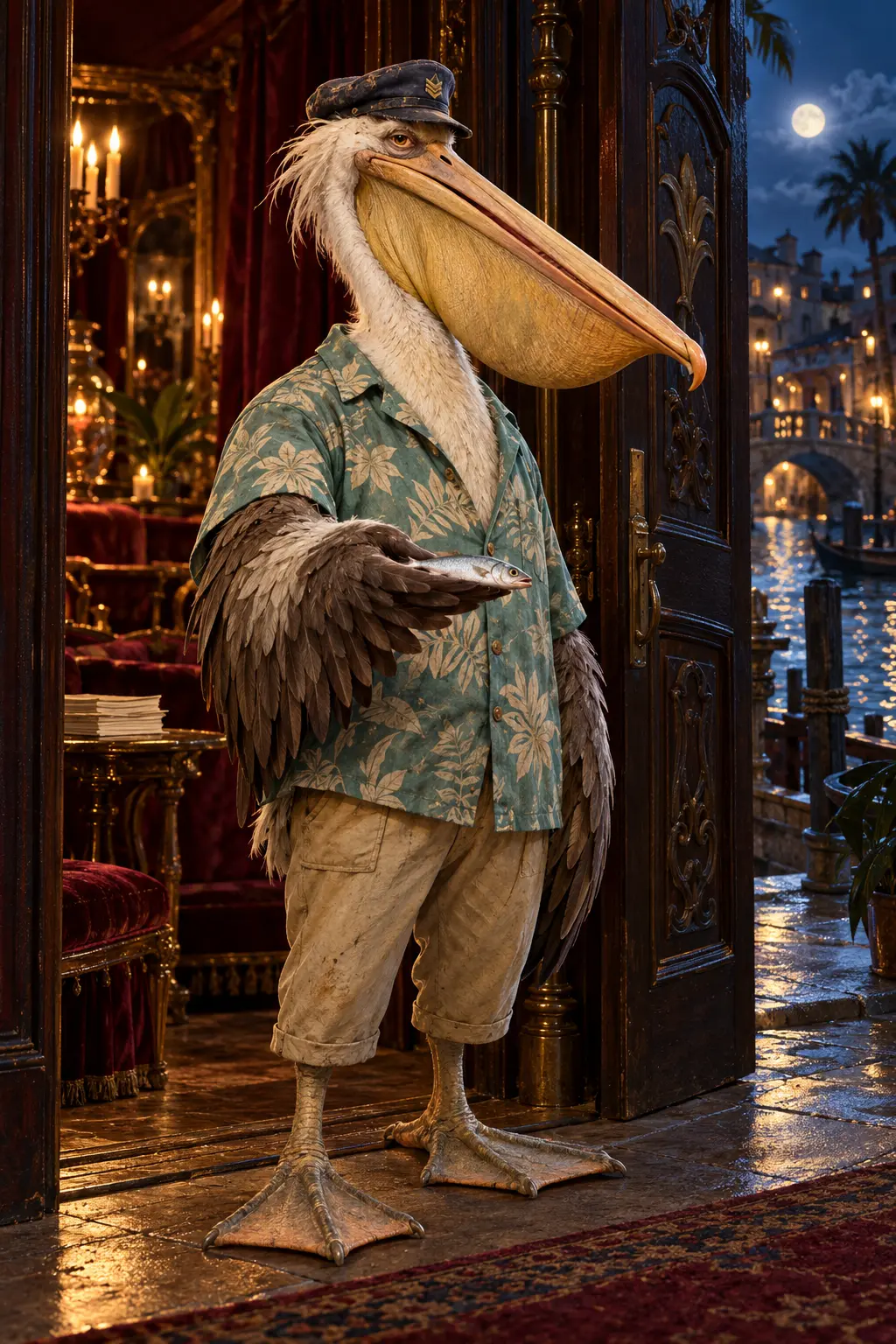
The first time Sergeant Pelican said he was retired, the bridge congratulated him.
The second time, it asked whether he wanted that in a warmer tone.
He stopped beneath the lower footbridge and looked up. Water tapped against the steps. On the boardwalk, a small striped awning shaded a counter with a brass bell and a price list.
ECHOES: ONE COPPER.
REASSURANCE: TWO.
ARGUMENTS: BRING YOUR OWN SECOND PARTY.
Behind the counter sat a narrow brown duck wearing a yellow scarf. Beside him was a speaking trumpet, its wide end pointing into the brick arch.
“Ordinary repetition?” the duck asked. “Or did you have something particular in mind?”
“I asked where the fish stall was.”
“Yes. A geographical inquiry. We don't cover those.”
“You said, ‘A distinguished bird deserves a distinguished lunch.’”
“Complimentary sample.”
The Sergeant examined the price list. Twenty years working a beach in Hawaii had introduced him to several ways of selling someone their own voice. This one at least provided shade.
A smartly dressed drake arrived, laid down two coppers and announced, “I have decided to grow a moustache.”
The duck lifted his trumpet.
“A BOLD AND HANDSOME DECISION,” said the bridge.
The drake touched the feathers above his bill and departed, considerably taller.
“Can he grow one?” asked the Sergeant.
“That is beyond the service.”
The duck put down his trumpet. His stomach made a small, decisive noise.
“Lunch?” said the Sergeant.
“At four.”
It was half past twelve.
“My relief hasn't arrived.”
“How long does an echo take to train?”
The duck looked him over: the battered service cap, the faded sea-green shirt, the bill that required its own share of the counter.
“Can you repeat a sentence?”
“Depends on the sentence.”
“It's usually the easy ones.”
His name was Pip. He explained the ordinary echo, the encouraging echo and the premium echo, which included a pause long enough to suggest that the bridge had given the matter serious thought.
“Nothing that will start a fight,” he added. “And don't promise anyone a clear complexion. We had a complaint.”
He placed a little stool behind the counter.
“Twenty minutes?”
“Get something hot.”
Pip hurried toward the fish stall. The Sergeant sat. The stool disappeared beneath him without complaint.
His first customer was a duck carrying a parcel of pink fabric.
“My sister says this color makes me look like a boiled prawn.”
The Sergeant considered the parcel.
“Does she like prawns?”
The duck blinked.
“Very much.”
“There you are.”
She laid down two coppers and left smiling. He decided the work was straightforward.
Then a goose in a pale linen jacket approached with three companions. He glanced at the counter, at the worn shirt behind it, and then at the trumpet.
“Good. I want to try something.”
He turned to face the water and opened his wings.
“NOBODY IN THIS CITY HAS BETTER TASTE THAN I HAVE.”
The Sergeant lifted the trumpet.
“NOBODY IN THIS CITY HAS BETTER TASTE THAN I HAVE.”
The words went under the arch, across the water and up the opposite steps.
One of the companions coughed.
The goose turned.
“You make it sound ridiculous.”
“Same sentence.”
“There should be more conviction.”
The Sergeant repeated it more loudly.
This time the fig seller across the canal looked up and laughed.
The goose deposited one copper and left. His companions followed at a careful distance.
A girl in a blue apron was next. She stood before the trumpet, opened her bill, closed it and looked toward the bakery at the end of the boardwalk.
“Take your time,” said the Sergeant.
“It's for an audition.”
“What is?”
“The song.”
“Then we'll need some of it.”
She gave him one copper. From her apron pocket she took a crumpled sheet of music.
“I'm supposed to be able to sing across the room.”
“How big a room?”
“The entire room.”
He moved the bell out of her way.
She sang three notes, very softly. A passing cart took all of them.
The Sergeant waited until the wheels had gone.
“Again.”
She tried. This time the notes reached the counter.
“Have you heard yourself from farther away?”
“How would I do that?”
He looked at the bridge, the speaking trumpet and the small steps on the opposite bank.
“Come with me.”
They crossed the footbridge. Halfway over, the girl said she could not afford a premium echo.
“Neither can I,” he said. “Keep walking.”
On the far side, he settled her beneath the arch and returned to the counter. The queue, which had acquired two ducks and a dog carrying a bread roll, watched him sit down.
“Temporary arrangement,” he told them.
He lifted the trumpet.
“READY?”
Across the canal, the girl nodded.
She began to sing.
Her first notes travelled along the curve of the brickwork and came back to her from above the water. She stopped, startled by the size of the sound.
The Sergeant lowered his trumpet.
“That yours?”
“Yes.”
“Thought so. Carry on.”
She began again. It was a waltz about a sailor who had left his heart in a harbor and returned to discover the rent had gone up. The Sergeant knew a different version. His contained a coconut and was unsuitable for the dog.
At the fig stall, the seller put down his scoop. A duck leaning out to shake a rug drew it back through the window. The girl reached the part she had been afraid of and, having nowhere else to go, sang it.
The note rose into the arch. It came back warm and clear.
A barge emerged from beneath the next bridge. On its deck, two ducks were sorting empty baskets. One began tapping the rhythm on a crate. The other knew the refrain.
The girl heard him and smiled. Her next line came more easily.
By the final verse, the fig seller had joined in. He knew almost none of the words but possessed an admirable quantity of voice.
Pip returned carrying two covered bowls and a roll.
He stopped beside the counter and set down the bowls.
“What's happened to my queue?”
The two ducks were dancing. The dog had gone to find somewhere quieter to eat.
“Improved,” said the Sergeant.
“My trumpet?”
“Here.”
“My bridge?”
“Still there.”
The song ended. The basket sorters applauded as their barge carried them away. The girl stood very still beneath the arch, one wing pressed to the pocket containing her music.
Then she ran up the steps.
Pip watched her cross.
“She's been coming all week,” he said. “Usually asks whether she ought to try.”
“She tried.”
“I heard.”
The girl arrived breathless. “Did that count as the audition?”
“Wrong audience,” said the Sergeant. “Good rehearsal.”
She laughed. “It's at three. Above the bakery.”
“Time for lunch, then.”
She offered another copper. He pointed to the original one, still beside the bell.
“Already paid.”
When she had gone, Pip took the stool. He opened his bowl. Steam drifted up around his scarf.
“I got you one as well.”
The Sergeant accepted the second bowl.
“Fish?”
“Chowder.”
“Distinguished.”
They ate while the afternoon traffic returned to its usual volume. Across the canal, the fig seller attempted the refrain once more. It was still largely about figs.
Pip counted the coins, then looked at his price list.
“I could add rehearsal space.”
“Keep the lunch break.”
Near three o'clock, Sergeant Pelican passed the bakery. Music came through an upstairs window. He stopped beside a tray of cooling rolls and listened.
The girl sang the difficult note.
This time it had to manage without a bridge.
It did.
The Sergeant nodded and went on toward the fish stall. He had missed lunch there, but this struck him as a temporary setback.
Behind him, a voice called from the upstairs window.
“Thank you!”
He raised one wing without turning.
Under the footbridge, Pip lifted his trumpet.
“THANK YOU!” said the city.
For once, nobody had paid it to.